You Just Finished Treatment. Now What?
You walked out of detox or rehab with a clearer head, a plan, and probably a little bit of that “okay, I can actually do this” energy. But here’s the real talk — where you go next matters just as much as the work you already put in. The environment you step into after treatment can either set you up for your biggest glow-up or pull you right back into old patterns.
That’s not just opinion — it’s science. A 2025 systematic review published in Frontiers in Psychiatry found that people in recovery housing consistently outperformed those in standard continuing care when it came to staying sober, earning more income, finding employment, and avoiding criminal charges. Your setting literally shapes your outcomes.
So if you’re weighing your options and wondering where to land, let us make the case for a city that hits different when it comes to early recovery: downtown San Diego.
Why Location Is Everything in Early Sobriety
Recovery isn’t just about willpower. It’s about access — access to support, structure, community, and honestly, things that make you want to keep going. The Substance Abuse and Mental Health Services Administration (SAMHSA) defines recovery as “a process of change through which individuals improve their health and wellness, live self-directed lives, and strive to reach their full potential.” Notice the key phrase there: self-directed lives.
That’s exactly what downtown San Diego is built for. It’s not isolated. It’s not clinical. It’s a real city with real opportunities — and every resource you need to build a life you’re actually excited about is within walking distance or a quick trolley ride away.
The data is clear: stable, supportive housing in connected communities is one of the strongest predictors of sustained recovery.
Recovery Resources Are Literally Everywhere Downtown
12-Step Meetings Within Walking Distance
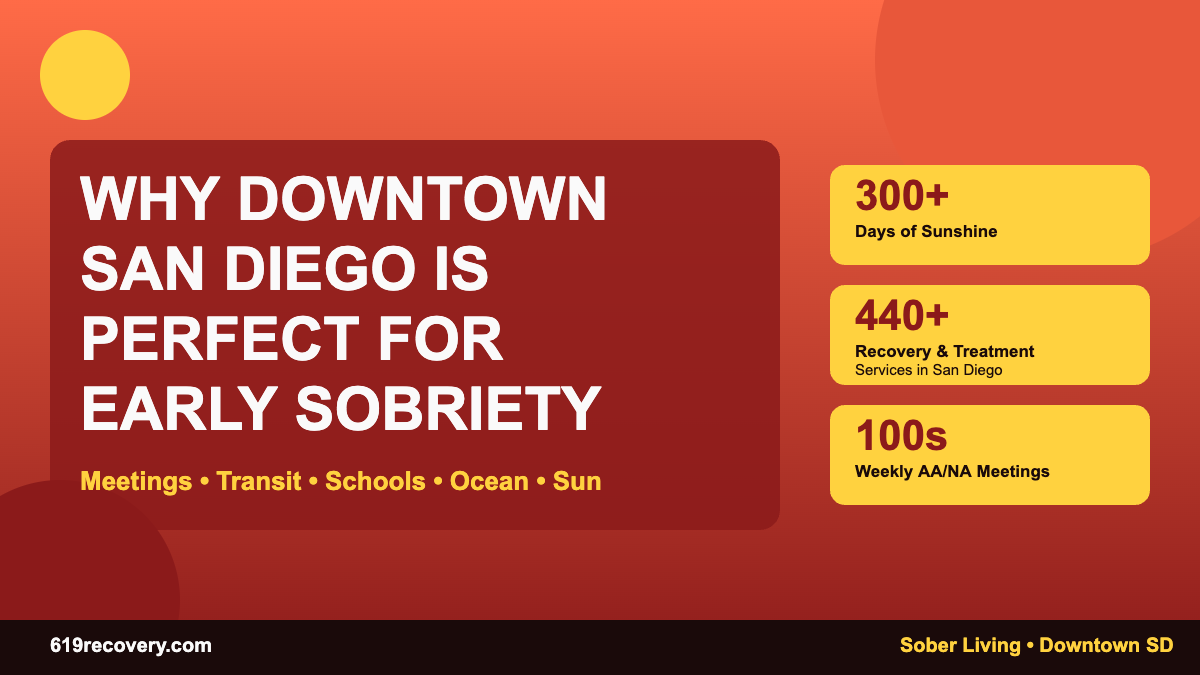
San Diego has one of the most active recovery communities in California — no cap. There are hundreds of AA and NA meetings happening every single week across the city, with a huge concentration in the downtown and East Village areas. Whether you vibe with traditional Big Book study, young people’s meetings, meditation meetings, or speaker meetings, there’s something for you any day of the week, morning to night.
The Alcoholics Anonymous San Diego Central Office coordinates meetings across the entire metro area, and you can find NA meetings through San Diego in Recovery. There are also SMART Recovery meetings for people who prefer a science-based approach, plus Cocaine Anonymous, Marijuana Anonymous, and Refuge Recovery groups for mindfulness-oriented support.
When your meetings are a five-minute walk from your apartment instead of a 30-minute drive, you actually go. That proximity removes one of the biggest barriers to sustained recovery — and it makes building a sober network feel natural, not forced.
State and County Support Services at Your Fingertips
San Diego County Behavioral Health Services operates a comprehensive network of support for people in recovery. Through 211 San Diego, you can connect to free counseling, case management, Medi-Cal enrollment, vocational rehab, and peer support specialists — all accessible from downtown.
California’s Department of Health Care Services (DHCS) also funds regional recovery support programs that provide everything from transportation vouchers to educational assistance. Living downtown means you’re already in the hub where these services are concentrated. No car needed. No long bus rides to some office park in the suburbs.
The Trolley Changes Everything
Let’s talk about something that doesn’t get enough credit in recovery conversations: public transportation. When you’re in early sobriety, most people don’t have a car, and that can feel isolating real quick. Downtown San Diego’s trolley system and bus network completely eliminate that barrier.
From the East Village — where 619 Recovery apartments are located — you can hop on the Blue Line trolley and be at the beach in 20 minutes, at SDSU in 25 minutes, or cruising through Mission Valley for work in under 15. The Green Line connects you to Old Town, UCSD Extension programs, and job centers across the county.
This isn’t just convenience — it’s independence. Research consistently shows that transportation barriers are one of the top reasons people drop out of recovery programs and support services. When you live in a walkable, transit-connected neighborhood, you stay plugged into everything that keeps your recovery strong.
Schools, Colleges, and Career Moves
Early sobriety is the perfect time to level up — and downtown San Diego puts you at the center of some serious educational and career opportunities:
San Diego State University (SDSU) is a quick trolley ride away and has a thriving collegiate recovery community with student-led meetings, peer support, and SMART Recovery groups on campus. UCSD Extension offers professional development and certificate programs that can fast-track your career without a four-year commitment. San Diego City College is literally in the heart of downtown — walking distance — with affordable programs in everything from tech to trades.
On the career side, downtown San Diego is a hub for hospitality, tech startups, healthcare, and creative industries. The Gaslamp Quarter alone has thousands of service industry jobs, and East Village is rapidly growing with new businesses that are hiring. When you live steps from the action, you don’t just apply for jobs — you show up, connect, and build something.
The Ocean, the Pier, and 300 Days of Sun
Here’s where San Diego really flexes on every other recovery city. You’re not just getting access to meetings and jobs — you’re getting the Pacific Ocean, the San Diego Bay, and over 300 days of sunshine every year.
Why does that matter for recovery? Because the science is overwhelming. A comprehensive review published in the International Journal of Environmental Research and Public Health found strong evidence that nature exposure is associated with improved cognitive function, better blood pressure, increased physical activity, improved sleep, and — crucially — better mental health outcomes including reduced depression and anxiety.
Another study published in Risk Management and Healthcare Policy found a direct positive association between sunlight exposure and mental health, concluding that increased daily sunlight significantly correlated with improved psychological wellbeing.
And it gets even more specific. Research published in Science Advances examined how different types of nature interaction — including walking along water, sitting by the ocean, and exercising outdoors — produce measurable psychological benefits. The researchers described these natural settings as offering “psychological ecosystem services” that actively reduce stress, restore attention, and promote positive mental states.
Translation? Walking to the pier after a morning meeting, watching the sunset from Harbor Drive, or jogging along the Embarcadero isn’t just a nice bonus — it’s clinically beneficial for your mental health and your recovery.
Exercise, Movement, and Brain Recovery
Speaking of movement — if you’re in early sobriety, your brain is literally rewiring itself. And exercise is one of the most powerful tools to help that process along.
A 2024 review in the International Journal of Environmental Research and Public Health analyzed dozens of studies and found that physical activity in recovery leads to reduced cravings, lower anxiety and depression, improved self-esteem, better sleep, and enhanced cognitive function. The review specifically highlighted that young people showed improved substance use outcomes including reduced frequency and amount of use when exercise was integrated into treatment.
Downtown San Diego makes staying active effortless. You’ve got:
Waterfront trails along the Embarcadero and Harbor Drive for running, walking, or biking. Balboa Park — one of the largest urban parks in the country — with hiking trails, gardens, and free outdoor fitness areas. Year-round outdoor yoga, bootcamp, and group fitness classes throughout East Village and the Gaslamp. Gyms and fitness studios within walking distance of just about anywhere downtown.
When your environment naturally encourages you to move, you don’t have to force the habit. It just becomes part of your life — and your recovery gets stronger because of it.
How the Right Environment Ties It All Together
Here’s what it comes down to: early sobriety isn’t about white-knuckling it through every day. It’s about building a life that actually supports the person you’re becoming. And that requires an environment where recovery resources, career opportunities, education, community, nature, and independence all intersect.
Downtown San Diego checks every single box. The meetings are here. The support services are here. The trolley connects you to everywhere you need to go. The schools and jobs are within reach. The ocean and sunshine are right outside your door. And the community of young adults building new lives in sobriety? They’re your neighbors.
At 619 Recovery, we designed apartment-style sober living around exactly this idea. Your own space in a real apartment — not a facility, not a clinical environment — in the heart of East Village where everything you need is already built into the neighborhood. Structure and accountability? Absolutely. But paired with the independence to build your own schedule, pursue your own goals, and live your own life.
Your Next Chapter Starts Here
If you’re leaving treatment and looking for a place that actually sets you up — not just a roof over your head, but a launchpad for the life you want — downtown San Diego is the move. And 619 Recovery is where that life begins.
You’ve already done the hardest part. Now it’s time to build something real.
Ready when you are.
Learn more at 619recovery.com.
Reviewed by 619 Recovery Clinical Team
What should I do in my first 30 days of sobriety?
Lock in basics first: a daily meeting (in person if possible), a sponsor or recovery mentor, a sleep schedule, and one form of movement. The first 30 days is mostly about removing decisions, not adding goals. Living somewhere structured — like 619 Recovery's downtown San Diego sober living — takes housing, food, and triggers off the table so you can focus on showing up.
Where can I find AA meetings in downtown San Diego?
Downtown San Diego has dozens of AA and NA meetings every week within walking distance of East Village. The aacentraloffice.org meeting finder and the SD Central Office at 7676 Hazard Center Dr both list current schedules. 619 Recovery residents typically have 5–8 walkable meeting options each day.
Helpful 619 Recovery resources
More from the 619 Recovery library
- →Sober Living Isnt Rehab: Heres What It Actuall
- →Halfway House vs Sober Living vs Recovery Residence: Which D
- →24 Hours in a Sober Living House: What Your Day Actually Loo
- →What Nobody Tells You About Living in a Sober Living House
- →What to Do in San Diego Without Drinking: 45 Sober-Friendly
- →Why 2026 Is Different for Mental Health
- →Sun, Sea, and Sobriety: The Ultimate Guide to Navigating Rec
- →Why Downtown San Diego Is the Ideal Location for Sober Livin
Related Reading
More from the 619 Recovery library: